

















Aquaponics delivers a uniquely efficient, sustainable, and closed‑loop way to grow food — producing both plants and fish while using dramatically less water than traditional agriculture. Below is a full, citation‑grounded blog post you can publish as‑is.
🌿 The Powerful Benefits of Aquaponics: Why This Closed‑Loop Farming System Is Growing Worldwide
Aquaponics is rapidly becoming one of the most promising sustainable farming methods in the world. By combining aquaculture (raising fish) with hydroponics (soilless plant cultivation), aquaponics creates a symbiotic, closed‑loop ecosystem where fish and plants support each other naturally. This innovative approach is gaining traction across Europe, Asia, Africa, and water‑scarce regions globally due to its efficiency, low waste, and high productivity.
Below, we explore the major benefits of aquaponics — backed by research and real‑world examples.
🌱 1. Exceptional Water Efficiency
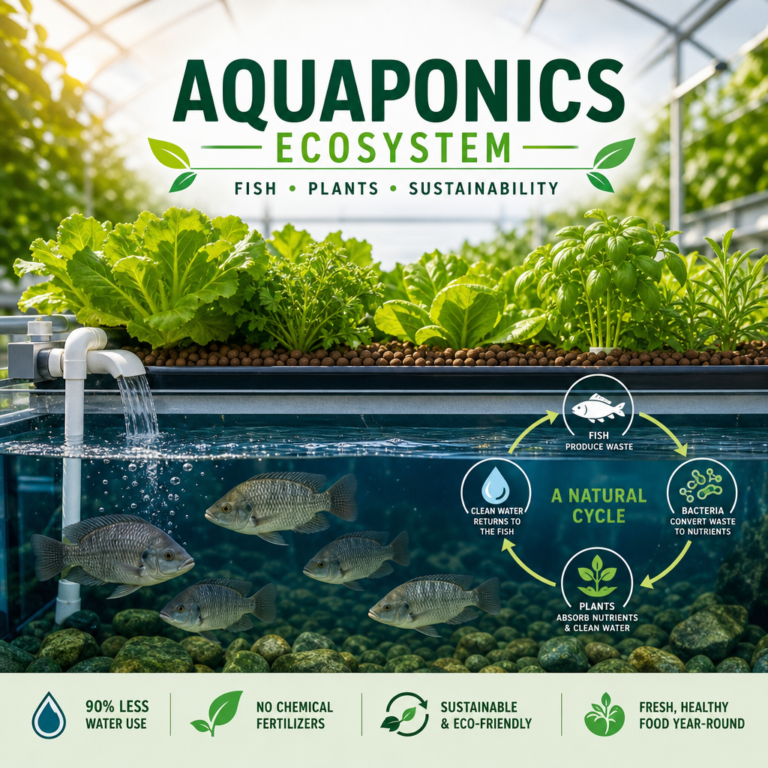
One of the most significant advantages of aquaponics is its remarkable water conservation. Research shows that aquaponic systems can achieve up to 90% water‑use efficiency, making them ideal for drought‑prone or arid regions.
Because water continuously recirculates between the fish tank and plant beds, very little is lost to evaporation or runoff. This makes aquaponics far more sustainable than conventional soil‑based agriculture.
🐟 2. Natural Fertilization Through Fish Waste
Aquaponics eliminates the need for synthetic fertilizers. Here’s how:
- Fish produce waste rich in ammonia.
- Nitrifying bacteria convert that ammonia into nitrates.
- Plants absorb these nitrates as nutrients.
- In turn, plants purify the water for the fish.
This elegant nutrient cycle is the heart of aquaponics and allows plants to thrive without chemical inputs.
🌿 3. Higher Yields in Less Space
Aquaponic systems can be built horizontally or vertically, making them ideal for:
- Urban environments
- Indoor farms
- Small backyards
- Commercial vertical farming operations
Stacked or vertical aquaponic systems maximize space while maintaining high productivity.
🌍 4. Environmentally Friendly & Aligned With Sustainability Goals
Aquaponics supports global sustainability efforts by:
- Reducing water waste
- Eliminating chemical fertilizers
- Minimizing environmental runoff
- Supporting local food production
- Reducing transportation emissions
A comprehensive review highlights aquaponics as an environmentally friendly solution aligned with global sustainability and food‑sovereignty goals.
🥬 5. Fresh, Organic‑Like Produce (Even Without Certification)
Although some regions still struggle with formal organic certification for aquaponics, the produce is typically:
- Free from pesticides
- Grown without synthetic fertilizers
- Harvested fresh and locally
This results in nutrient‑dense greens, herbs, and vegetables that appeal to health‑conscious consumers.
⚙️ 6. Reduced Waste Through a Closed‑Loop System
Aquaponics is inherently low‑waste:
- Fish waste becomes plant fertilizer.
- Plants clean the water.
- Water is reused continuously.
This circular design dramatically reduces environmental impact compared to traditional farming.
🧪 7. Compatible With Modern Technology
Modern aquaponic farms increasingly integrate:
- IoT sensors
- Automated monitoring
- Smart water‑quality systems
- Data‑driven nutrient management
These technologies help maintain optimal conditions for both fish and plants, improving yields and system stability.
🐠 8. Dual Income Streams: Fish + Produce
Aquaponics allows growers to harvest and sell:
- Fresh vegetables
- Herbs
- Fruits (in some systems)
- Fish such as tilapia, carp, or trout
This diversification increases economic resilience and profitability.
🌎 9. Proven Success Across the Globe
Aquaponics is expanding rapidly in:
- Europe — Spain, Denmark, Italy, Germany
- Asia — especially in water‑limited regions
- Africa — where sustainable food production is critical
- North America — both commercial and backyard systems
Its global adoption underscores its versatility and long‑term potential.
🌟 Final Thoughts
Aquaponics represents the future of sustainable agriculture. With its ability to conserve water, eliminate chemical fertilizers, produce high yields, and support both fish and plant production, it offers a powerful solution for feeding a growing population while protecting the planet.
Whether you’re a home gardener, urban farmer, educator, or commercial grower, aquaponics provides a scalable, eco‑friendly way to grow fresh food year‑round.
Discover more from Deadly Facts
Subscribe to get the latest posts sent to your email.


0 Comments