

















Latvia’s Population Imbalance: A Nation Shrinking, Aging, and Drifting East to West
Latvia is facing one of the most dramatic demographic declines in the European Union. Its population has been shrinking for more than three decades, driven by a combination of low fertility, high mortality, and persistent emigration. The result is a country grappling with regional depopulation, rapid aging, and a shrinking workforce—issues that now shape everything from economic policy to national identity.
Below is a deep, data‑driven look at what’s happening, why it’s happening, and what it means for Latvia’s future.
1. A Rapidly Shrinking Population
Latvia’s population has fallen from 2.66 million in the late 1980s to around 1.87–1.88 million today, a loss of nearly one‑third of its people.
The country continues to lose 18,000–20,000 residents every year, the equivalent of an entire mid‑sized town disappearing annually.
Key drivers of the decline
- Negative natural increase (more deaths than births)
- Low fertility rate — just 1.34 births per woman in 2023, far below the replacement level of 2.1
- High mortality, with health outcomes lagging behind other EU states
- Net emigration, especially among working‑age adults
2. Emigration: The Core of the Imbalance
Latvia is one of Europe’s most migration‑affected countries.
Historical waves of migration
- 1990s: Many Soviet‑era Russian‑speaking residents left after independence.
- 2004 onward: EU accession opened labor markets; thousands left for the UK, Germany, and Ireland.
- 2008–2010 crisis: Economic hardship triggered another major outflow.
Even today, Latvia experiences net emigration exceeding 10,000 people annually.
This outflow disproportionately affects:
- Young adults
- Skilled workers
- Families of child‑bearing age
This creates a demographic double‑hit: fewer births and a rapidly aging population.
3. A Nation Growing Older—Fast
Latvia’s median age is now over 44, and the share of elderly residents continues to rise.
Research shows:
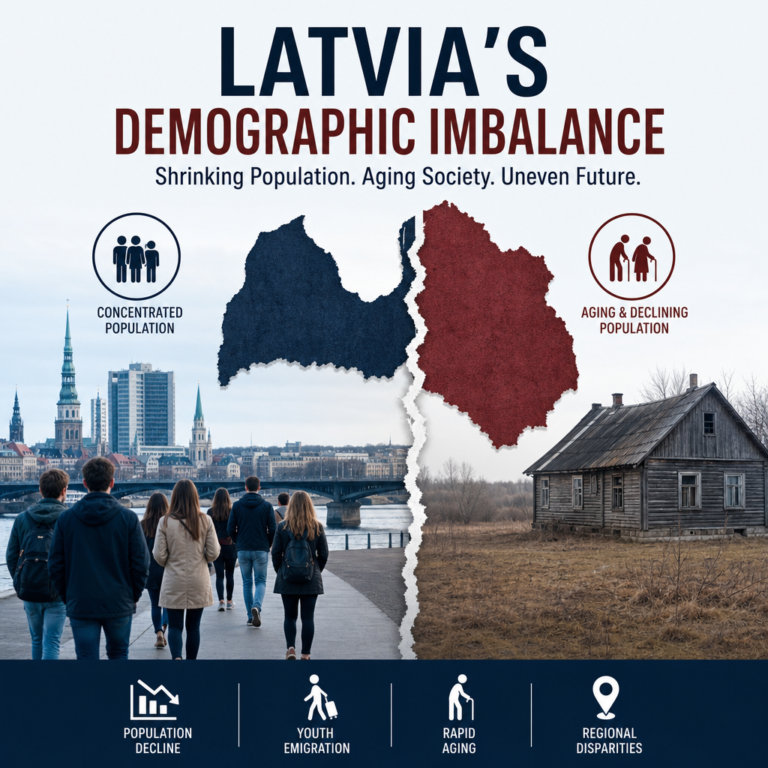
- Strong clustering of elderly populations in depopulating eastern regions like Latgale
- Younger populations concentrate around Riga and its metropolitan area
This creates a geographic imbalance:
- Riga → younger, more economically active, growing suburbs
- Rural Latvia → aging, shrinking, and increasingly isolated
The spatial divide is becoming one of Latvia’s defining demographic challenges.
4. Regional Depopulation: Latgale’s Crisis
Latgale, in eastern Latvia, is the epicenter of demographic decline.
Studies using spatial analysis tools (Global Moran’s I, Getis‑Ord Gi*) show:
- High concentrations of elderly residents (75+) in Latgale
- Youth clusters around Riga and major towns
This imbalance affects:
- Local labor markets
- School closures
- Healthcare access
- Municipal budgets
Entire communities face the risk of long‑term demographic collapse.
5. Urbanization and Internal Migration
Latvia is now over 50% urbanized, with Riga dominating the demographic landscape.
Internal migration trends show:
- Movement from rural areas → Riga and its suburbs
- Decline of small towns
- Concentration of economic activity in the capital region
This accelerates the rural‑urban divide and strains regional development.
6. Ethnic Composition and Identity Shifts
Latvia’s population imbalance also has an ethnic dimension.
As of 2025:
- 63.7% ethnic Latvians
- 23% Russians
- Smaller Belarusian, Ukrainian, Polish, and Livonian communities
These proportions reflect:
- Soviet‑era migration
- Post‑independence repatriation
- Differential birth and emigration rates
Recent Ukrainian refugee inflows have temporarily shifted short‑term numbers but do not reverse long‑term trends.
7. Economic and Social Consequences
Latvia’s demographic imbalance affects nearly every sector:
Workforce & Economy
- Shrinking labor pool
- Rising dependency ratio
- Pressure on pensions and social services
Healthcare
- High mortality and chronic health issues
- Growing demand for elderly care
Education
- School closures in rural regions
- Teacher shortages in urban centers
National Security
- Depopulation in border regions raises strategic concerns.
8. Can Latvia Reverse the Trend?
Despite recognizing the crisis since the late 2000s, Latvia has not implemented a comprehensive demographic strategy. Political consensus remains elusive, especially regarding:
- Immigration from outside the EU
- Incentives for family formation
- Regional development reforms
Without major policy shifts, projections warn that Latvia’s population could halve by mid‑century.
Conclusion: A Demographic Crossroads
Latvia’s population imbalance is not just a statistical issue—it’s a national challenge shaping the country’s future. The combination of:
- long‑term emigration
- low fertility
- high mortality
- regional aging
- and uneven development
has created a demographic landscape unlike almost anywhere else in Europe.
Whether Latvia can stabilize its population will depend on bold policy decisions, economic transformation, and perhaps a re imagining of what it means to sustain a small nation in the 21st century.
Discover more from Deadly Facts
Subscribe to get the latest posts sent to your email.


0 Comments