

















In a world where over 2 billion people lack access to safe drinking water, the concept of “water bankruptcy” is no longer a distant threat—it is a present reality. Traditional solutions, such as desalination, are often energy-intensive, expensive, and environmentally taxing.
However, a revolutionary advancement in chemistry may provide a life-changing alternative. Professor Omar Yaghi, a 2025 Nobel Laureate and pioneer of reticular chemistry at the University of California, Berkeley, has unveiled a technology capable of extracting clean, drinkable water directly from the atmosphere, even in the driest conditions on Earth.
The Science: Molecular Engineering at Work
The heart of this innovation lies in Metal-Organic Frameworks (MOFs). These are ultra-porous, synthetic materials designed at the molecular scale. To understand their efficiency, consider this: just a few grams of these engineered materials possess an internal surface area equivalent to a football stadium.
These MOFs act like “super-sponges.” As air passes through the device, the microscopic pores within the MOFs selectively trap water molecules.
How the Off-Grid Generator Works
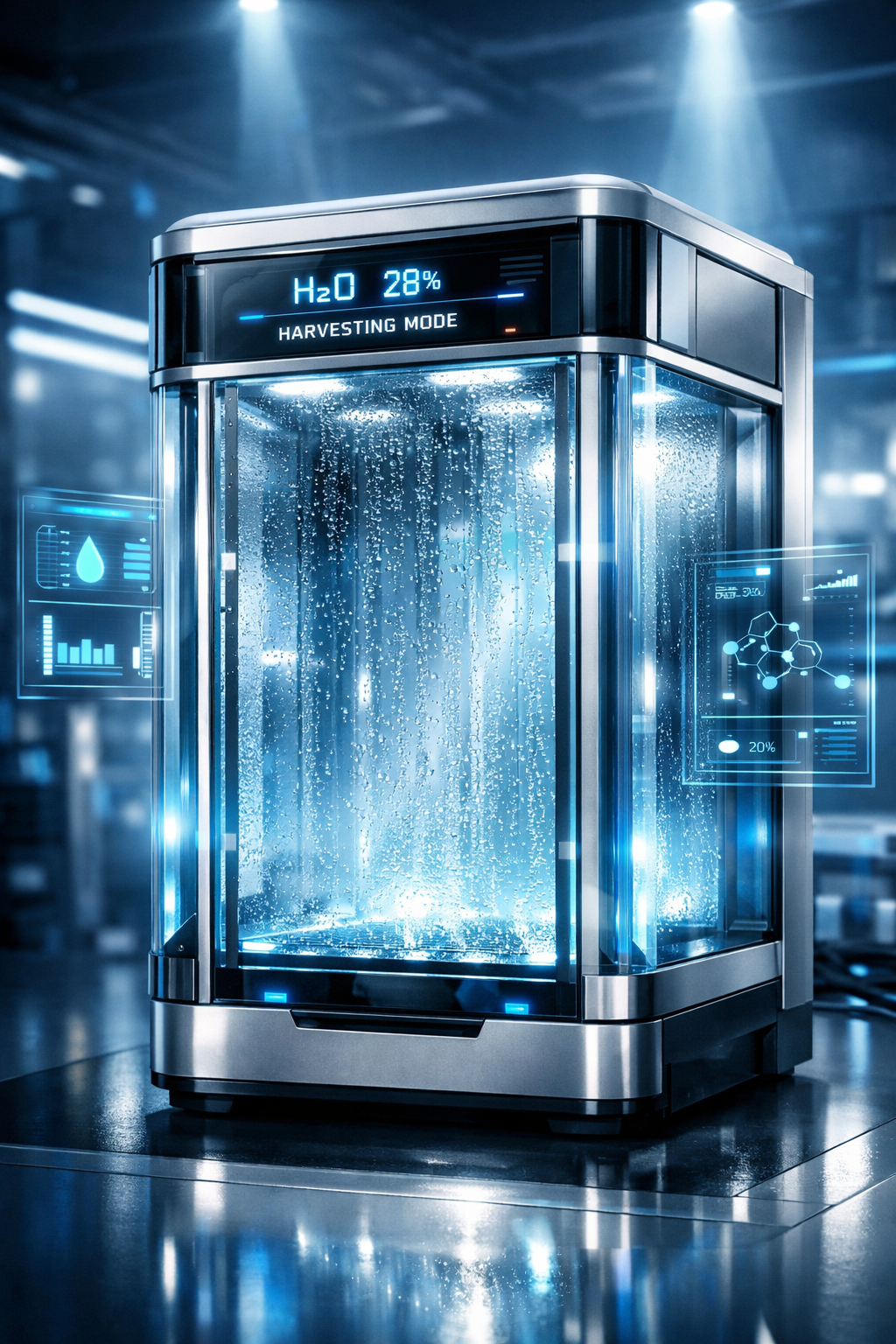
Unlike conventional atmospheric water generators that rely on electricity-intensive cooling systems to condense water, the system developed by Yaghi and his company, Atoco, is designed to be truly sustainable:
-
Passive Capture: The system captures water vapor from the air, even in environments with humidity levels as low as 20%.
-
Solar-Powered Release: When exposed to ambient sunlight or low-grade thermal energy, the MOFs release the trapped moisture as vapor.
-
Condensation: This vapor is then condensed into clean, liquid water.
Because the process is powered by solar heat rather than electricity, the units are completely off-grid. Encased in structures roughly the size of a 20-foot shipping container, these generators can be deployed in remote desert communities, disaster-stricken zones, or island nations struggling with water insecurity.
A Vision for “Personalised Water”
Professor Yaghi’s commitment to this technology is deeply personal. Growing up in a refugee community in Jordan, he experienced firsthand the challenges of living without reliable access to water. He envisions a future where water production is decentralized—much like how solar panels have allowed households to generate their own electricity, Yaghi hopes to enable communities to generate their own “personalized water.”
Impact on Global Water Security
As climate change intensifies droughts and makes traditional water infrastructure more vulnerable to extreme weather, the need for resilient, localized solutions has never been greater.
The successful deployment of these units could offer rapid relief to communities following natural disasters, such as those seen in the Caribbean, and provide a sustainable lifeline for millions living in arid regions. By bridging the gap between molecular innovation and practical, community-level application, Yaghi’s technology represents a hopeful step toward a more water-secure future.
Would you like to learn more about the specific molecular structure of MOFs or how reticular chemistry enables these custom-designed materials?
Discover more from Deadly Facts
Subscribe to get the latest posts sent to your email.


0 Comments