
















Imagine if sitting in bumper-to-bumper traffic didn’t mean choking on exhaust fumes. What if every car on the road acted less like a polluter and more like a tree, scrubbing the air clean while you drive?
It sounds like science fiction, but a brilliant team of student innovators has made it a reality. Meet the Go Green Filter—an innovative, student-built exhaust attachment that harnesses the natural power of microalgae to turn toxic vehicle emissions into fresh, breathable oxygen.
Here is how these young minds are turning a biological superpower into a weapon against climate change.
The Problem Lurking in Our Exhaust
Traditional internal combustion engines release a nasty cocktail of gases, including carbon dioxide ($CO_2$), nitrogen oxides ($NO_x$), and particulate matter. While electric vehicles are on the rise, millions of gas-powered cars will remain on the road for decades.
We need a solution for the cars we are driving right now.
Enter the Go Green Filter: How It Works
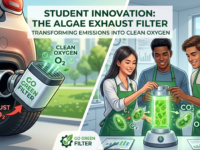
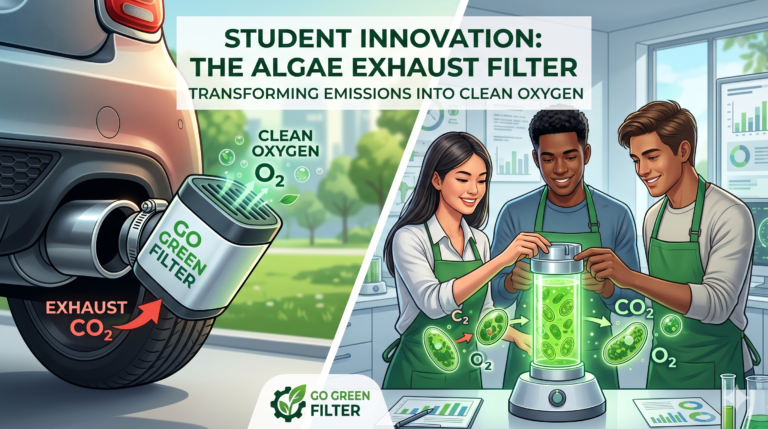
The Go Green Filter is a compact, cylindrical device that clamps directly onto a standard vehicle tailpipe. Instead of relying solely on heavy metals and chemical catalysts like a traditional catalytic converter, this filter uses a living, breathing component: microalgae.
Here is the step-by-step breakdown of how it works:
-
Capture: As exhaust gases flow out of the tailpipe, they are diverted into the filter’s specialized intake chamber.
-
Cooling and Diffusing: Because exhaust can be incredibly hot, the gases pass through a miniature cooling matrix before being diffused as tiny bubbles into a liquid bioreactor core.
-
The Photosynthesis Engine: This core is packed with a resilient strain of microalgae suspended in a nutrient-rich solution. As the $CO_2$ bubbles through the liquid, the algae rapidly consume it, utilizing the heat and light to trigger accelerated photosynthesis.
-
The Clean Output: The algae break down the carbon dioxide, locking away the carbon to grow more biomass, and release pure oxygen ($O_2$) out of the filter’s vents.
Why Algae? Microalgae are earth’s original air purifiers. They perform photosynthesis at a rate up to 10 times faster than terrestrial plants, making them the perfect candidate for a high-intensity job like scrubbing vehicle exhaust.
Key Features of the Innovation
-
Highly Adaptable: The student team designed the filter with a universal adapter, allowing it to fit onto most standard exhaust pipes, from sedans to delivery vans.
-
Low Maintenance: The filter features a self-contained ecosystem. Car owners simply need to swap out the algae cartridge during their routine oil changes.
-
A Circular Economy: The used, carbon-rich algae cartridges don’t go to waste. They can be collected and processed into biofuels, organic fertilizers, or even bioplastics.
The Big Picture: Why This Matters
What makes the Go Green Filter so inspiring isn’t just the science—it’s the creators. Developed in a school lab by a group of students refuse to accept air pollution as a given, this project proves that game-changing environmental solutions don’t always come from massive corporate R&D departments. They come from passion, ingenuity, and a willingness to look at old problems through a green lens.
By turning vehicles from carbon creators into oxygen generators, the Go Green Filter bridges the gap between our fossil-fuel present and a zero-emission future.
What’s Next?
The student team is currently refining their prototype to withstand extreme winter temperatures and maximize the filter’s lifespan. They are also looking for partners to help scale production for a pilot program in local public transit buses.
The next time you see exhaust rising from a tailpipe, don’t just think about the pollution. Think about the Go Green Filter, and a future where our commutes actually help the planet breathe a little easier.
What do you think about the Go Green Filter? Would you install an algae bioreactor on your car to help clean the air? Let us know in the comments below!
Discover more from Deadly Facts
Subscribe to get the latest posts sent to your email.


0 Comments